The information on this site is to be used for informational purposes only and is not intended or implied to be a substitute for professional CPA or accountant advice. It is important to visit a highly specialized CPA firm in New York with top rated, best in class NYC accountants regarding creative ideas customized to your specific needs. Visit a leading Accounting firm in NYC and Queens, NY Miller & Company LLP. We are taking an exceptional individual care of each client.
Miller & Company, LLP provides 1031 exchange CPA services for real estate investors throughout New York City (with offices in Midtown Manhattan, Queens and Long Island), Florida (with offices in Sarasota and Fort Myers) and Washington, DC. CPA Paul Miller strongly encourages you to bring in a 1031 exchange accountant before you close on a potential 1031 exchange real estate transaction. Call the best 1031 exchange tax advisor to potentially defer capital gains tax on real estate sales, improving your savings and reducing your tax burden.
What Are the 1031 Exchange Tax Rules?
The 1031 exchange tax rules allow investors to defer capital gains tax by exchanging one qualifying investment or business property for another under Section 1031 of the Internal Revenue Code (IRC). Because the rules apply only to certain transactions, make sure an experienced 1031 exchange CPA reviews the ownership structure, replacement property and exchange requirements before you undertake the transaction to identify potential issues early and help structure the transaction to satisfy the IRS requirements.
A 1031 exchange tax advisor knows how 1031 exchange real estate works, so consulting one before you enter into a transaction provides you more options than trying to address tax issues after closing. Miller & Company, LLP assists real estate investors throughout New York City, Florida and Washington, DC with pre-transaction tax guidance and like-kind exchange tax planning.
“The best tax planning starts when your CPA sees the transaction well before preparing your tax return,” says founder Paul Miller, CPA. “Depending on the property involved, a review may include cost segregation services to evaluate depreciation strategies. We provide that as well.”
What Is Like-Kind Exchange Tax Planning?
Like-kind exchange tax planning involves organizing a real estate transaction so it satisfies the requirements of Section 1031 before the exchange takes place. Although the phrase “like-kind” often causes confusion, it generally refers to the nature of the property — as either an investment or business real estate — rather than requiring two identical properties. Understanding this distinction may influence which replacement properties to consider and how to structure the transaction.
A 1031 exchange accountant at Miller & Company reviews the ownership, financing, type of replacement property and supporting documentation to confirm that the proposed exchange aligns with IRS requirements. Because every transaction has its own tax implications, your tax accountant typically reviews the details before you finalize the agreement. Investors with long-term wealth preservation goals may include gift and wealth transfer tax planning when future ownership or succession is part of your overall strategy.
When Do I Need 1031 Exchange Tax Planning?
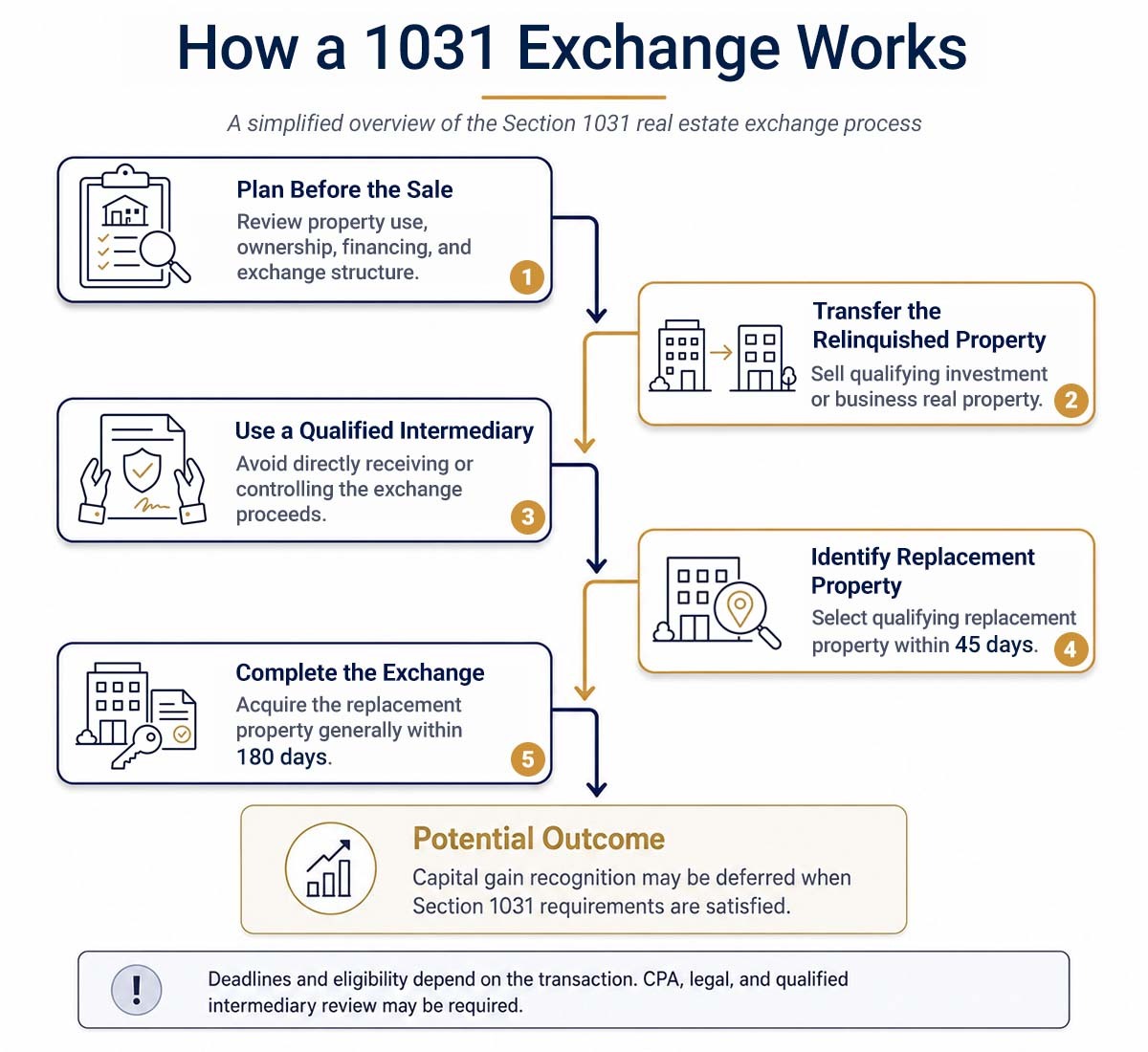
1031 exchange tax planning should begin before you sell a business or investment property. Working with a 1031 exchange CPA before the sale gives you time to evaluate ownership, replacement property options and whether the proposed exchange satisfies IRS requirements. Advanced planning is particularly important for reverse exchanges because those transactions require additional steps before you transfer either property.
Miller adds: “Not every real estate transaction qualifies under Section 1031. Property held for your personal use, inventory held for resale and exchanges that fail to meet the IRS requirements generally don’t receive tax-deferred treatment. Qualifying exchanges also follow strict deadlines, meaning you must identify replacement property typically within 45 days and acquire it within 180 days.”
Early coordination with your broker, attorney, lender and qualified intermediary supports your business tax strategy and corporate tax planning. Consider consulting a 1031 exchange tax advisor when your transactions involve:
Selling rental, commercial or other investment properties
Buying replacement property in another state
Holding real estate through an LLC, partnership or other entity
Planning to defer capital gains tax from real estate sales through a qualifying exchange
What Happens During a 1031 Exchange Accountant Review?
Your 1031 exchange accountant reviews more than the purchase and sale documents. The CPA typically examines how the property has been used, its ownership, financing and the proposed exchange structure. Those details help determine whether the transaction qualifies for tax-deferred treatment and how it should be reported.
Supporting records establish the property’s tax history, not simply its sale price. Depreciation schedules, improvement costs, financing records, ownership documents and exchange paperwork all verify the transaction. The review may also address related-party transactions, debt changes or exchanges involving multiple properties if those factors affect the proposed exchange.
When multiple states or ownership entities are involved, multi-state tax accounting becomes part of the review and plan. Documentation typically reviewed for 1031 exchange tax planning includes:
Purchase and sale agreements for both properties
Settlement statements, depreciation schedules and improvement records
Qualified intermediary agreements, exchange notices and identification documents
Loan payoff information, financing records and ownership documents
When Can I Defer Capital Gains Tax on Real Estate Transactions?
You may defer capital gains tax on real estate transactions by completing a qualifying like-kind exchange under Section 1031 of the IRC. For many investors, these transactions form part of broader tax minimization strategies for high-income individuals and business owners seeking to preserve long-term investment capital. You can defer the gains when you identify and acquire a replacement property within the IRS time limits for a qualifying exchange.
“The tax is deferred rather than eliminated,” says Miller, “making capital gains tax planning an important consideration when you eventually sell the replacement property. Like-kind exchange tax planning also extends beyond the statutory deadlines because financing changes, debt relief, cash received and ownership issues all affect the final tax outcome. Review these matters before you close to provide greater flexibility.”
Frequently Asked Questions (FAQs) about 1031 Exchanges
Can I live in the replacement property after the exchange?
In most situations, not immediately. The replacement property should first satisfy the IRS requirements for investment or business use before it’s converted to personal use.
Will I owe tax if I receive cash from the exchange?
Possibly. Receiving cash or other non-like-kind property may create taxable gain, even if the remaining exchange qualifies for tax deferral.
Does refinancing affect a 1031 exchange?
It can. Changes to financing or debt may affect your tax outcome, depending on the timing and structure of the refinancing.
How Do I Schedule a Consultation with a 1031 Exchange CPA?
A 1031 exchange is most effective when your tax accountant becomes involved before you sign any contracts. Early guidance gives your 1031 exchange CPA time to identify the potential tax issues, review the documentation and coordinate with others while changes are still possible. Addressing those matters in advance has a better chance of deferring capital gains tax for real estate transactions.
Before your consultation, gather purchase records, depreciation schedules, ownership information, financing documents, qualified intermediary details and information about the proposed replacement property. Contact Miller & Company, LLP to schedule a consultation with a 1031 exchange CPA before your next real estate closing.
Stay Connected
Creative advice and outstanding performance
Expect a thorough commitment to excellence. Creative advice and outstanding performance — merged with relentless dedication and vigilant customer service — mean that your CPA responds quickly to requests and questions. Accounting experts are just a phone call away.
A full-service consulting and accounting firm in New York
“Nothing less than the best.” That’s what current and former clients say about Miller & Company. It’s that reputation for excellence that drives successful individuals and businesses to work with this team.
The financial expertise you’ll find at Miller & Company is unparalleled in the Manhattan and New York City areas. Your personal CPA gets to know who you are — identifying the objectives you have and the challenges you face. Then, using a wide range of innovative business strategies, you’ll receive breakthrough solutions that no other accountants thought possible.
Professionalism is more than certifications and degrees
Professionalism is more than certifications and degrees -- all of which you’ll find at Miller & Company. Professionalism at Miller & Company means you’re always treated with the respect you deserve. Professional CPAs embrace their commitment.
When you contact this New York City accounting team, you receive the most up-to-date information, the most innovative financial concepts and the best possible solutions. You get accountants honesty and integrity necessary to earn your trust. Your satisfaction is paramount.