The information on this site is to be used for informational purposes only and is not intended or implied to be a substitute for professional CPA or accountant advice. It is important to visit a highly specialized CPA firm in New York with top rated, best in class NYC accountants regarding creative ideas customized to your specific needs. Visit a leading Accounting firm in NYC and Queens, NY Miller & Company LLP. We are taking an exceptional individual care of each client.
While ecommerce rides the present wave of online shopping and is certain to continue well into the future, too many businesses gravitating toward online sales haven’t updated their internal procedures. To take full advantage of the latest trends, you need to include accounting services for e-commerce business. It takes a specialized ecommerce accountant to manage all your online sales. Miller & Company, LLP, with offices in New York City, Florida and Washington, DC, is the most experienced e-commerce accounting firm. Call today for a consultation.
Why Does Ecommerce Accounting Need a Different Approach?
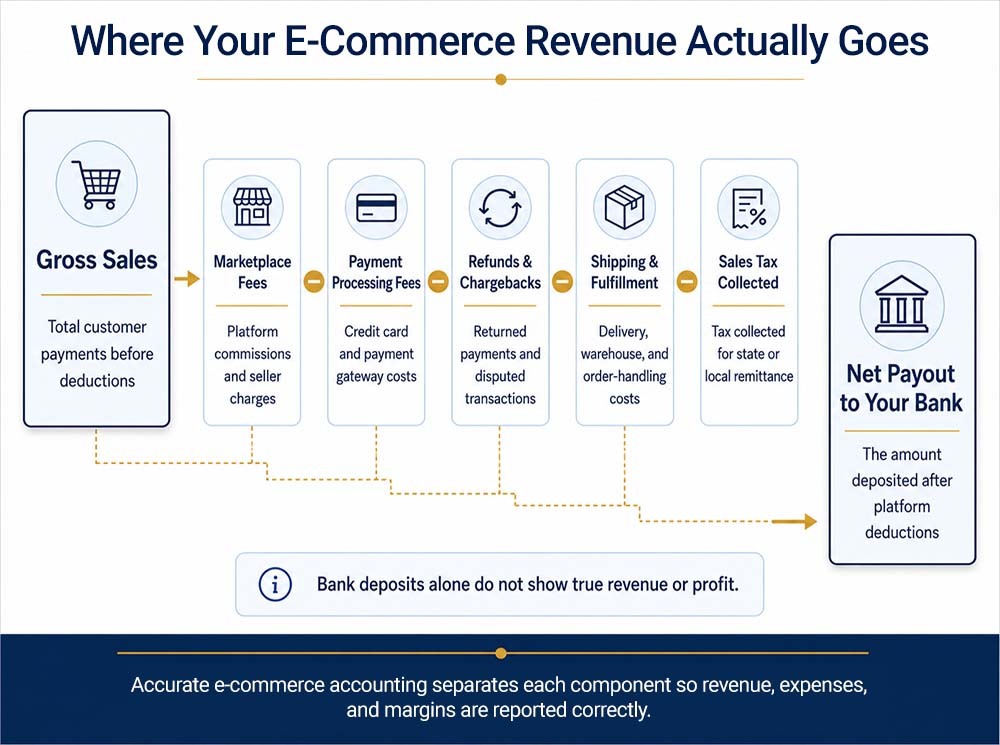
E-commerce accounting doesn’t look like a standard small business setup. In fact, it’s not even close. When you sell across multiple platforms, each one hits you with different fees, payout timelines and reporting formats. Each order you fulfil pulls money in three directions at once. The marketplace, the payment processor and shipping each takes its cut, leaving you with the rest to pay costs and taxes before you make any profit.
Amazon pays you every two weeks. Stripe pays you every day. Basic bookkeeping tools pull in all those transactions and call it a day. Everything gets tagged as revenue and you have no idea what actually hits your account or why. E-commerce businesses need more than that.
An ecommerce CPA from Miller & Company, LLP organizes your books the way ecommerce actually runs. Gross sales stay separate from fees, refunds and shipping costs. And when refunds come in, they go into your records that same week, not months down the line when the damage is already done.
“An ecommerce business needs an e-commerce accountant who understands things like platform fees and tax law,” says Paul Miller, CPA and founder of Miller & Company. “Lumping everything into one revenue line hides where your margin really goes.”
What Inventory Challenges Does Accounting for E-Commerce Business Actually Solve?
When you have an ecommerce accountant on your team, that professional catches inventory issues before they hit your bottom line. Your cost of goods sold doesn’t stay fixed. It moves every time a supplier adjusts pricing, a customer sends a product back or your stock shifts between warehouses. Generic software wasn’t built for that. Instead, its assumptions — such as, one location and one price — falls apart fast.
Proper ecommerce accounting tracks multiple warehouses and multiple suppliers to track a sale long after it closed. An e-commerce accountant reviews your product and fulfilment data to catch costs that include:
Landed costs on every order, including freight and customs fees, so that nothing sneaks into your numbers later
Returns that get logged the week they come back, so you never discover months later that your revenue was off the whole time
The individual fee breakdown for every warehouse and 3PL you work with, so there’s no more guessing where fulfilment costs are piling up
Records of damaged or missing inventory, logged right away, before it quietly pulls your margins down without explanation
Tracking every pricing gap — whether you sell on your own site, Amazon or another platform — so everything, every part of that sale, is accounted for
An ecommerce accounting firm CPA checks these costs against your sales every month. You don’t have to wait until year-end to find out where the money went. The monthly review finds shrinkage before it hurts your margins next quarter. When your sales cross into new states, the same discipline keeps your sales tax under control.
How Does an Ecommerce Tax Accountant Handle Multi-State Sales Tax?
“Our e-commerce tax accountants track where your sales create a tax obligation, not just where your business finances sit,” says Miller. “Most states set an economic nexus at $100,000 in sales, a standard that traces back to the Supreme Court’s Wayfair ruling. A few larger states set the bar higher. Cross that number within a state, and you owe sales tax there, even without a local office or warehouse.”
Marketplace facilitator laws add a twist, as well. Amazon, Etsy and similar platforms now collect and remit sales tax on orders placed through them in every state. While that service lifts the obligation off your plate, you still have to track your own website’s sales. In many states, your marketplace sales still count toward your nexus threshold. Multi-state tax accounting support at Miller & Company watches these factors, such as:
Your ecommerce sales, tracked by state against every threshold you’re approaching
Marketplace sales handled separately from your own direct website sales
Registration and filing in every state where your business crosses a threshold
Exemption certificates that cover your wholesale and resale customers
Inventory sitting in your fulfilment center that creates a nexus on its own, because that same exposure carries into any wholesale sales you run alongside retail orders
Frequently Asked Questions (FAQs) about Accounting Services for E-Commerce Businesses
Does an e-commerce business need a specialized accountant?
Yes. Ecommerce accounting is far superior to generic bookkeeping, which often misses platform fees, multi-state sales tax and inventory costs.
What is a 1099-K and does it affect my ecommerce taxes?
The IRS requires a 1099-K to report your gross platform payments, not your profit. You still owe tax based on what you actually earned.
Does Miller & Company offer accounting services for ecommerce business owners on multiple platforms?
Yes. Miller & Company offers accounting services for ecommerce business owners selling across their site, Amazon, Etsy and other platforms.
How does Miller & Company handle wholesale and retail accounting together?
Paul Miller’s accounting firm tracks your wholesale and retail sales as separate profit centers under one clean set of books.
How Does an E-Commerce CPA Help with My Retail and Wholesale Accounting?
An ecommerce CPA looks at your retail and wholesale sales as two different businesses under one roof. Retail customers pay sales tax and expect fast shipping. Wholesale buyers pay net terms, buy in bulk and qualify for a resale exemption. Treating both sides the same way in your books hides how each one actually performs.
A wholesale customer buying at a discount looks identical to a full-price retail sale unless the books separate them. Accounting services for ecommerce business at Miller & Company, LLP offers e-commerce accounting services built around this split. Your retail margin and your wholesale margin are tracked separately.
“A wholesale order and a retail order need different accounting from the moment they hit your books,” says Miller. Your business tax strategy ties directly into how that split shapes your decisions, including:
Retail and wholesale that stay separate so you see where your money comes from
Every wholesale buyer with a resale certificate on file
Bulk pricing and discounts, which show up correctly in your margins
All orders reconciled in one clean process
Retail customers pay right away. Wholesale buyers pay on net terms, sometimes 30 or 60 days out. Keep those two separate in your books and you get a clear picture of where your growth is actually happening. Contact Miller & Company to schedule a consultation. They’re your ecommerce accounting firm in New York City, Florida and Washington, DC.
Stay Connected
Creative advice and outstanding performance
Expect a thorough commitment to excellence. Creative advice and outstanding performance — merged with relentless dedication and vigilant customer service — mean that your CPA responds quickly to requests and questions. Accounting experts are just a phone call away.
A full-service consulting and accounting firm in New York
“Nothing less than the best.” That’s what current and former clients say about Miller & Company. It’s that reputation for excellence that drives successful individuals and businesses to work with this team.
The financial expertise you’ll find at Miller & Company is unparalleled in the Manhattan and New York City areas. Your personal CPA gets to know who you are — identifying the objectives you have and the challenges you face. Then, using a wide range of innovative business strategies, you’ll receive breakthrough solutions that no other accountants thought possible.
Professionalism is more than certifications and degrees
Professionalism is more than certifications and degrees -- all of which you’ll find at Miller & Company. Professionalism at Miller & Company means you’re always treated with the respect you deserve. Professional CPAs embrace their commitment.
When you contact this New York City accounting team, you receive the most up-to-date information, the most innovative financial concepts and the best possible solutions. You get accountants honesty and integrity necessary to earn your trust. Your satisfaction is paramount.