The information on this site is to be used for informational purposes only and is not intended or implied to be a substitute for professional CPA or accountant advice. It is important to visit a highly specialized CPA firm in New York with top rated, best in class NYC accountants regarding creative ideas customized to your specific needs. Visit a leading Accounting firm in NYC and Queens, NY Miller & Company LLP. We are taking an exceptional individual care of each client.
While the U.S. tax code changes on a regular basis, it never gets any easier to comprehend. Offshore tax compliance in particular is a complex morass of rules that can leave you stumped. Mistakes and missed offshore income reporting deadlines lead to hefty fines. Avoid the issues involved in foreign trust tax reporting and offshore income tax filing by relying on experienced offshore CPA who understands the international tax codes and federal tax filing requirements. Call Miller & Company, LLP to start a conversation about offshore tax compliance.
What Do I Need to Know about Offshore Tax Compliance?
Offshore tax compliance reflects your legal obligation to report all foreign accounts, assets and income to the Internal Revenue Service (IRS) every year. Under IRS Section 61, U.S. citizens and residents owe offshore income tax on worldwide income. It doesn’t matter where your money is held.
“Most people don’t realize how broad these rules are. A foreign bank account with just $10,001 triggers a federal filing requirement,” says Paul Miller. A certified public accountant and founder of Miller & Company, LLP, Miller is dedicated to wealth preservation for high-net worth individuals and business owners.
Miss the filing deadlines, and the penalties you face rank among the highest in the entire tax code. Miller and his team of offshore CPA experts in New York City, Florida and Washington, DC examine your full offshore financial picture and handle every required filing. Knowing what triggers your obligation is just the starting point.
What Foreign Accounts Trigger an Offshore Income Reporting Requirement?
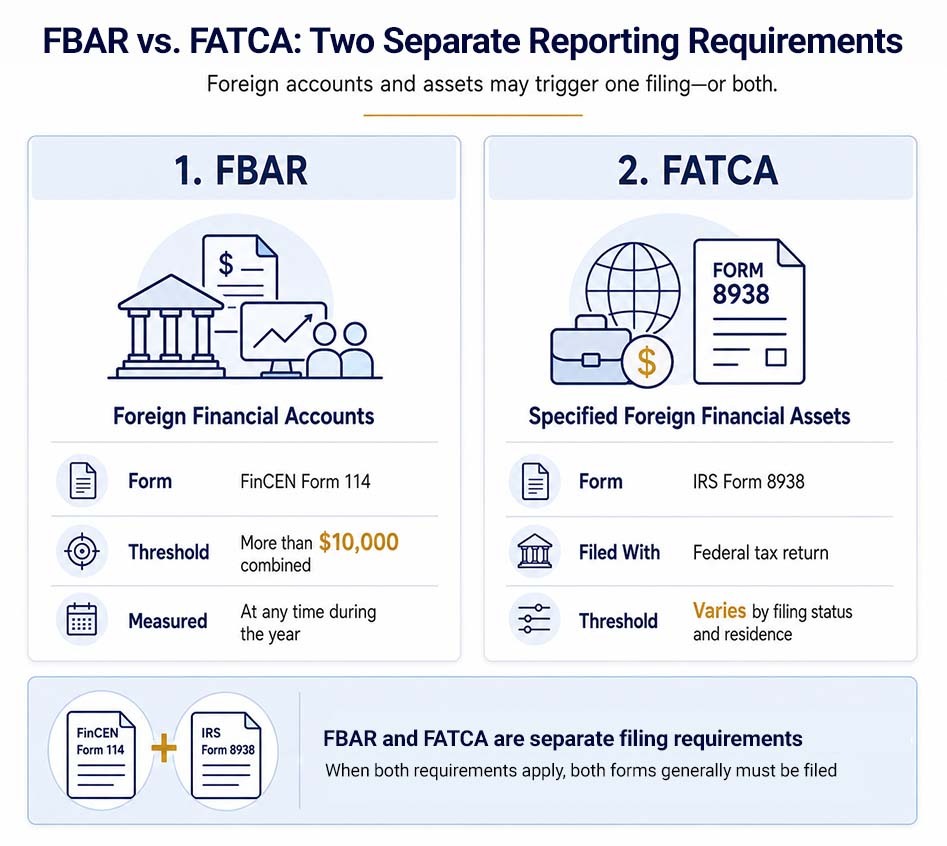
The Bank Secrecy Act details your reporting obligation. It starts the moment your foreign accounts reach $10,000 in combined value at any point during the year, not just at year-end. The accounts and assets that trigger offshore income reporting requirements include:
Foreign bank accounts you hold alone or jointly with someone else
Investment and brokerage accounts at foreign financial institutions
Foreign mutual funds, pension plans or retirement accounts you contribute to or hold
Ownership interest in foreign corporations or partnerships
Foreign trusts where you’re the grantor, owner or beneficiary
Cryptocurrency in foreign exchanges, which now falls under IRS scrutiny
Your offshore CPA reviews your full financial picture before developing your filing strategy. Foreign Bank and Financial Accounts Report (FBAR) and Foreign Account Tax Compliance Act (FATCA) filing requirements differ by account type and understanding. Knowing which rules cover your accounts is the next step.
What’s the Difference Between FBAR and FATCA for Offshore Income Reporting?
FBAR and FATCA are two separate systems with different thresholds, different agencies and different forms. Your offshore tax compliance CPA guides you to file the correct documentation to ensure you stay on the right side of international tax laws. You must file appropriately with the Financial Crimes Enforcement Network (FinCEN).
FATCA, enacted under IRC Section 6038D, requires you to file Form 8938 with your federal tax return. For U.S. residents, the threshold is $50,000 at year-end or $75,000 at any point. Foreign banks also report your accounts to the IRS under FATCA. Filing one form doesn’t replace the other. If you cross both thresholds, you file both. Offshore income tax obligations under FBAR and FATCA run side by side.
“I see this constantly,” says Miller. “You file an FBAR and think you’re done. But if your foreign assets are large enough, you must file Form 8938 too. The penalties for missing these filings are expensive.”
What Are the IRS Penalties for Offshore Tax Non-Compliance?
The IRS and FinCEN enforce offshore income reporting penalties under Title 31 of the U.S. Code without exception. For FBAR, a non-willful violation carries a civil penalty of up to $16,536 per report. A willful violation can reach as high as $165,353 or 50 percent of your account balance, whichever is greater. Criminal penalties climb to $250,000 and up to 10 years in prison.
FATCA penalties under Form 8938 start at $10,000. The IRS adds $10,000 for every 30 days of non-compliance after the notice, up to $50,000. A 40 percent accuracy penalty applies to any unreported offshore income tied to your assets.
Miller adds: “Without the guidance of an expert offshore income tax CPA, you may be penalized, even though you weren’t trying to hide any income. I explain the IRS programs that help you correct past non-compliance without facing the maximum penalties.”
Who Needs to File Foreign Trust Tax Reporting Forms?
Under IRS Section 6048, foreign trust tax reporting applies if you create a foreign trust or transfer assets into one. It also applies if you own any portion of a foreign trust or receive a distribution from one. The obligation stands even if it paid out nothing. The main forms for foreign trust tax reporting include:
Form 3520, to report your transactions with a foreign trust or foreign gifts you received
Form 3520-A, filed by the foreign trust itself, but you face penalties if it fails to file
Form 8938 under FATCA, capturing the foreign trust assets as specified foreign financial assets
FinCEN Form 114, which applies when your trust holds foreign financial accounts
How your trust is classified changes your entire tax picture. A foreign grantor trust flows income directly onto your personal tax return. A foreign non-grantor trust is taxed separately. Your offshore CPA determines the correct classification before filing your forms. Additionally, your capital gains tax planning and gift and wealth transfer planning both connect to how your offshore trust gets reported. If you’re behind on these filings, there is a resolution path.
What Happens if I’m Behind on Offshore Income Reporting?
Offshore tax compliance is complicated, so the IRS gives you structured ways to fix missed offshore tax filings. Which applies to you depends on why you fell behind. If you hold foreign accounts but didn’t know about the filing requirement, for example, the IRS Streamlined Filing Compliance Procedures cover you.
U.S. residents may file three amended returns and six years of FBARs, with a five percent penalty on your highest unreported balance. Living abroad, your penalty drops to zero. The Delinquent FBAR Submission Procedures let you submit the missing reports with a written explanation. The IRS states it doesn’t impose a penalty when you meet the criteria.
“Filing late FBARs on your own without using the right program is a mistake,” says Miller. “The IRS calls that a quiet disclosure and treats it as an attempt to bypass the official process. It’s often when multi-state tax accounting obligations surface — when your foreign income intersects with state filings.”
Why Should I Work with an Offshore CPA?
An offshore CPA handles FBAR, FATCA, foreign trust forms and state obligations together. Missing the connection between any two of these creates tax exposure for you. Business tax strategy and business tax preparation services intersect with your offshore compliance picture, so you need a well-rounded CPA with expertise in foreign trust tax accounting and offshore tax compliance.
U.S. tax law leaves no room for error when foreign accounts and income are involved. The experts at Miller & Company, LLP deliver the precision your situation deserves. Contact them today to schedule a consultation.
Stay Connected
Creative advice and outstanding performance
Expect a thorough commitment to excellence. Creative advice and outstanding performance — merged with relentless dedication and vigilant customer service — mean that your CPA responds quickly to requests and questions. Accounting experts are just a phone call away.
A full-service consulting and accounting firm in New York
“Nothing less than the best.” That’s what current and former clients say about Miller & Company. It’s that reputation for excellence that drives successful individuals and businesses to work with this team.
The financial expertise you’ll find at Miller & Company is unparalleled in the Manhattan and New York City areas. Your personal CPA gets to know who you are — identifying the objectives you have and the challenges you face. Then, using a wide range of innovative business strategies, you’ll receive breakthrough solutions that no other accountants thought possible.
Professionalism is more than certifications and degrees
Professionalism is more than certifications and degrees -- all of which you’ll find at Miller & Company. Professionalism at Miller & Company means you’re always treated with the respect you deserve. Professional CPAs embrace their commitment.
When you contact this New York City accounting team, you receive the most up-to-date information, the most innovative financial concepts and the best possible solutions. You get accountants honesty and integrity necessary to earn your trust. Your satisfaction is paramount.