The information on this site is to be used for informational purposes only and is not intended or implied to be a substitute for professional CPA or accountant advice. It is important to visit a highly specialized CPA firm in New York with top rated, best in class NYC accountants regarding creative ideas customized to your specific needs. Visit a leading Accounting firm in NYC and Queens, NY Miller & Company LLP. We are taking an exceptional individual care of each client.
Don’t wait until tax time to engage the services of a tax minimization CPA. Much of the tax minimization strategies available to you rely on timing and choices that your accountant has to determine well in advance of the tax deadlines. For the best tax efficiency for high earners in NYC, Florida and Washington, DC, the accounting firm of Miller & Company, LLP offers the finest, most in-depth and effective tax-saving strategies for your particular situation. Call today for a consultation.
Who Needs Tax Minimization Strategies?
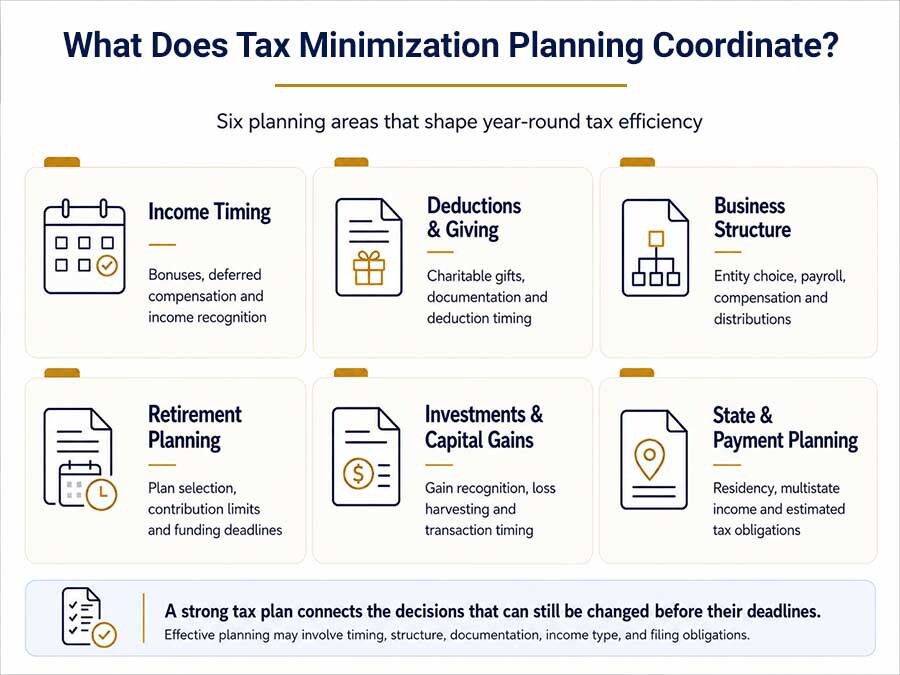
Tax minimization strategies benefit high-income individuals and business owners, especially when new income pushes them into a higher bracket that triggers added investment taxes or larger estimated payments. A tax minimization CPA considers tax saving strategies for you that include income timing, deductions, company setup, investment gains, location filing issues and payment deadlines. Situations that can shift the amount you owe for federal, New York and investment tax include:
Bonuses
Business sales
Stock option exercises
An unusually profitable year
Missing a planning window leaves more of your earnings exposed to taxes because your CPA didn’t review a better deduction, timing or entity choice early enough. In New York City, Florida and Washington, DC, an expert tax minimization CPA gets the best results by connecting your cash flow, portfolio activity and business operations well before year-end deadlines, when you’ve already set your filing positions.
Paul Miller, CPA and founder of Miller & Company, LLP, add, “A strong tax plan starts with your whole financial picture, not one isolated deduction. For business owners, this often means that I pair your individual tax planning with your business tax strategies and corporate tax planning, when you’re deciding your payroll, distributions, depreciation and year-end purchases.
How Do I Achieve Tax Efficiency as a High Earner?
High-income taxpayers minimize their tax liability when the planning work happens ahead of the filing deadline. Legal tax minimization planning to reduce taxable income is best accomplished when the available moves match the facts. Income timing, deductions, estimated payments, stock compensation and state residency each affect your tax return. Address these items before finalizing your tax bill.
The IRS reminds taxpayers that “the tax law places limits” on retirement plans and IRA contributions, so high earners should verify the annual number before funding their accounts. Those limits tend to change, and eligibility depends on many factors, such as your filing status and the type of account.
The practical question isn’t only how much you can contribute, but whether a traditional IRA deduction, Roth strategy, SEP, SIMPLE or cash balance plan best fits your situation. The tax minimization CPAs at Miller & Company review your income, plan access, cash flow and structure before making a recommendation. For high earners, planning areas include:
Preparing tax minimization strategies with qualified retirement contributions before deadlines
Timing bonuses, stock option exercises and deferred compensation
Which Tax-Saving Strategies Reduce Taxable Income?
The right tax-saving approach depends on the kind of income you’re earning. Wages, pass-through earnings, rental revenue, dividends, interest, capital gains and trust distributions don’t follow the same rules.
“A strategy that reduces taxable income for a partner doesn’t help an executive with mostly wages and restricted stock,” says Miller. “Good planning separates choices you still control from amounts already fixed.”
High earners need to distinguish lowering income from improving tax efficiency. A charitable gift may create a deduction, but its timing, asset type, documentation and itemized deduction requirements determine its value. The wrong asset, missing support or bunching gifts in the wrong year may reduce the benefit you expect. Charitable giving tax planning compares appreciated securities, donor advised funds and multi-year giving before you give the gift.
How Does Legal Tax Minimization Work for Business Owners?
Business owners usually have more flexibility. An experienced small business CPA reviews your entity structure, owner compensation, benefits, depreciation, accounting method and timing. Pass-through rules, wage limits, basis and entity type may change whether a tax benefit is usable. A deduction that looks strong on paper may lose value when you include payroll, state treatment or owner income. Coordinated planning is valuable for S corporations, partnerships, LLCs and closely held companies.
Deductions also require substance, timing and documentation. Depreciation rules depend on the property type, placed in service date, business use and the method selected for tax reporting. A cost segregation CPA may identify parts of a property with shorter recovery periods. Accelerating depreciation only makes sense when the tax result, cash flow, financing and state treatment support the choice. A Miller & Company CPA routinely covers year-end review points, such as:
Comparing your owner salary and distributions with the entity structure
Looking at whether state add-backs change your federal benefit
How Do Investment Decisions Affect Tax Efficiency for High Earners?
The tax rate on a stock or property sale often changes when the gain is recognized. IRS Topic 409 explains that net capital gains are taxed at different rates, depending on your overall taxable income, while short-term gains are taxed as ordinary income. That difference may affect the timing of a stock sale, real estate transaction, fund distribution or business exit. Your decision should also include your net investment income tax, state taxes and capital loss carry-forwards.
Investment choices also influence your estate and family goals. Estate, gift and trust rules change, so your planning shouldn’t depend on one year’s threshold. Gift and wealth transfer planning compares annual exclusion gifts, basis issues, control terms and cash needs before the assets move. Families in New York City, Florida and Washington, DC with business interests, real estate, concentrated stock or trusts need to coordinate their tax, valuation, liquidity and future filing support before moving assets.
What Records Should a Tax Minimization CPA Review?
Current records show what’s changed since last year’s return. Your tax minimization CPA uses that file to identify income spikes, missed deductions, uneven estimated payments, investment gains and transactions that need action before a deadline. Your tax accountant reviews whether a strategy is practical or only attractive on paper. For a planning meeting with your tax minimization CPA, useful documents include:
Current pay statements and expected bonus details
Business profit and loss reports
Investment gain and loss reports
Real estate purchase, sale and improvement records
Charitable gift receipts and appraisal documents
An organized file shows which amounts are fixed, which choices still have time to change, and which deductions need support before filing. This review makes the discussion practical instead of theoretical. After that, a deadline order becomes easier to set.
Frequently Asked Questions (FAQs) about Tax Minimization Strategies
When should high earners schedule a tax review?
Schedule a review before the year-end, when compensation, sales, profit, residency or estimates can still change.
Should tax-saving strategies wait until filing season?
Some choices can wait, but payroll and entity records often cannot.
Which documents matter most in tax strategies for high income earners?
Prioritize deadline-sensitive items tied to compensation, entity changes, investments and residency.
What should I ask my tax minimization CPA?
Ask which entity, payroll, retirement, depreciation and state choices have deadlines.
How often should legal tax minimization be reviewed?
Review it after major income, ownership, family, investment or location changes.
How Should I Start Tax Minimization Strategies?
A tax planning review turns an analysis into a ranked task list, with one owner, one deadline and one reason for each move. Miller & Company, LLP clarifies whether the next action involves payroll, brokerage activity, estate documents or bookkeeping. The most useful meeting leaves you knowing what to do first and what should stay confidently unchanged.
For taxpayers with complex income streams, a focused consultation before year-end preserves more choices. A year-round plan lowers exposure while keeping the return supportable and tied to current records. Contact Miller & Company to schedule a consultation for tax minimization strategies for you.
Stay Connected
Creative advice and outstanding performance
Expect a thorough commitment to excellence. Creative advice and outstanding performance — merged with relentless dedication and vigilant customer service — mean that your CPA responds quickly to requests and questions. Accounting experts are just a phone call away.
A full-service consulting and accounting firm in New York
“Nothing less than the best.” That’s what current and former clients say about Miller & Company. It’s that reputation for excellence that drives successful individuals and businesses to work with this team.
The financial expertise you’ll find at Miller & Company is unparalleled in the Manhattan and New York City areas. Your personal CPA gets to know who you are — identifying the objectives you have and the challenges you face. Then, using a wide range of innovative business strategies, you’ll receive breakthrough solutions that no other accountants thought possible.
Professionalism is more than certifications and degrees
Professionalism is more than certifications and degrees -- all of which you’ll find at Miller & Company. Professionalism at Miller & Company means you’re always treated with the respect you deserve. Professional CPAs embrace their commitment.
When you contact this New York City accounting team, you receive the most up-to-date information, the most innovative financial concepts and the best possible solutions. You get accountants honesty and integrity necessary to earn your trust. Your satisfaction is paramount.