The information on this site is to be used for informational purposes only and is not intended or implied to be a substitute for professional CPA or accountant advice. It is important to visit a highly specialized CPA firm in New York with top rated, best in class NYC accountants regarding creative ideas customized to your specific needs. Visit a leading Accounting firm in NYC and Queens, NY Miller & Company LLP. We are taking an exceptional individual care of each client.
Where you claim residency may determine how much state taxes you pay. If you have multiple homes, businesses, family or long-term residency in multiple states, your tax filing becomes complex. Let a NYC tax CPA experienced with residency tax laws and residency tax audits handle all your filing before you try to explain your variable resident locations. Call the best New York residency tax CPA at Miller & Company, LLP for a consultation.
What Is a Residency Tax Audit?
A residency tax audit is a process aimed at examining whether the residency status reported on your state income tax return is accurate. If you live in or are relocating from New York, these audits often arise after you claim residency in another state while continuing to maintain meaningful connections to New York.
The outcome of the audit determines whether you’re taxed as a resident or nonresident, which has a significant effect on your New York income tax liability. For many taxpayers, residency decisions also become part of broader tax planning, including Tax Minimization Strategies for High-Income Individuals and Business Owners, since changing residency often affects your overall state tax exposure.
Miller & Company, LLP advises taxpayers who are relocating or responding to residency tax audits. They have New York City offices in Midtown Manhattan, Queens and Long Island. They also have offices in Washington, DC and in Sarasota and Fort Myers, FL.
Founder and CPA Paul Miller says: “The strongest residency positions are built before you file your returns, when important decisions can still be documented properly. Your residency review may also involve business tax strategy and corporate tax planning if a move affects business ownership, entity structure or ongoing operations in New York. Taking a proactive approach is often easier than trying to recreate years of records after an audit begins.”
How Does New York State Determine My Residency Status?
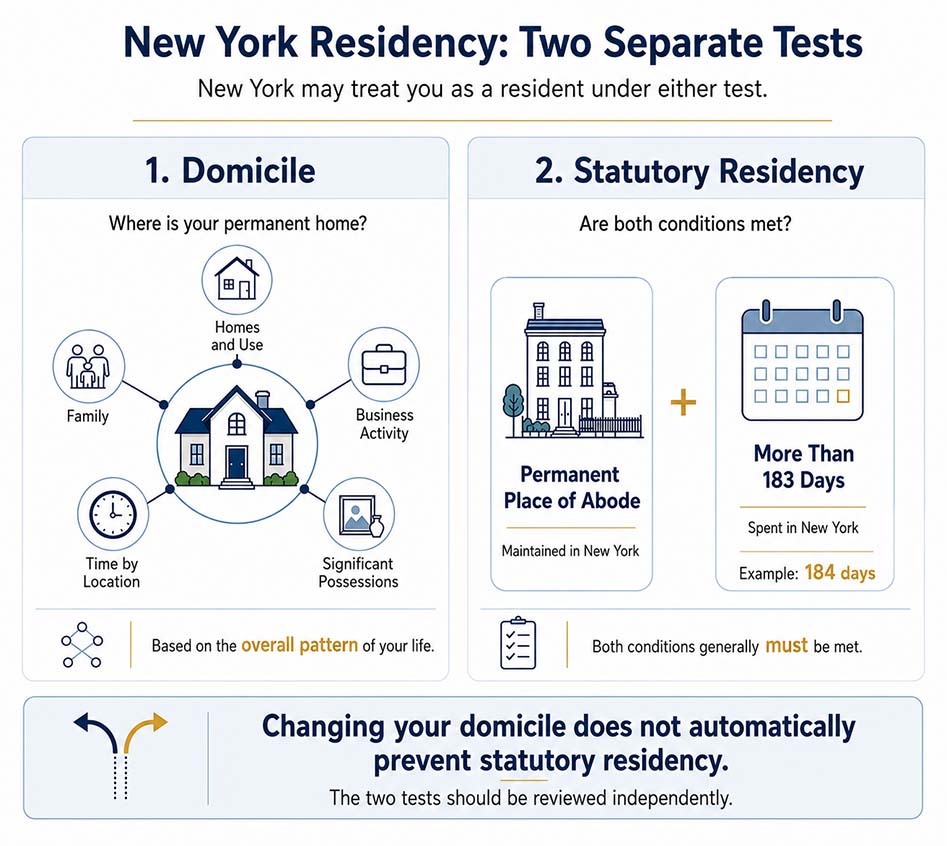
New York relies on two separate legal tests to decide if you should be taxed as a resident:
Statutory residency asks whether you meet specific legal requirements, as verified through records and day counts. Domicile asks a different question by finding where your permanent home and long-term life are actually centered. Depending on your circumstances, New York may review one test, both tests or move between them before reaching a decision.
Because the tests serve different purposes, satisfying one does not automatically satisfy the other. That’s why two taxpayers with similar living arrangements may receive different outcomes, depending on the facts supporting their residency position.
When Does Statutory Residency Apply?
Statutory residency can apply even if you believe you successfully moved out of New York. In general, the residency tax rules apply when you maintain a permanent place of abode in New York and spend more than 183 days in the state during the tax year. Unlike domicile, this test is based on verifiable facts through day counts, travel records and other documents. Buying a home in Florida or Texas may be an important step, for example, but your records still need to support the residency position you reported on your return.
Miller adds: “This test catches many taxpayers off guard. You may focus on proving that you established a home somewhere else, instead of asking whether you still satisfy New York’s statutory residency rules. Those are two different questions, which is why a move that feels complete may still result in New York treating you — and taxing you — like a resident.”
Reviewing the statutory residency rules before relocating can prevent expensive tax surprises later. A NYC residency tax CPA at Miller & Company can explain that, during a residency tax audit, New York may consider factors, such as:
Your permanent place of abode in New York during the tax year
The number of days you spent in New York
Your continued access to your New York residence
Whether your reported residency position aligned with your living arrangements
Whether your records supported your treatment as a resident or nonresident
What Factors Determine My Domicile?
Your domicile is the place you consider your permanent home. But proving that you’ve changed it usually takes more than updating paperwork. Buying another home, changing your mailing address or getting a new driver’s license all support your position. By themselves, however, these steps rarely answer the question.
“New York wants to see whether you actually left your former home behind and established another permanent home somewhere else,” says Miller. “No single document or life event can usually determine your domicile. Instead, auditors look at your family, finances, business activities and day-to-day living patterns to determine whether they consistently support your claim that you established a new permanent home.”
When those different parts of your life point in the same direction, your residency position is generally much easier to support during an audit. Common factors to consider and be able to prove include:
The location and use of your primary residence
Where your spouse and immediate family live
Your active business involvement and professional activities
The amount of time you spend in each location
Where valuable or personally significant possessions are kept
Your participation in community, religious or social organizations
What Records Support My Residency Position?
The records you keep can become just as important as the explanation you give during a residency tax audit. Auditors typically review documents covering the entire tax year, rather than focusing on isolated transactions or short periods of activity. Your records should retell your residency story for the audit to be successful.
When your documentation falls short or shows conflict, more questions arise. The strength of your residency position often depends on the consistency of your records, rather than the volume of documents you provide. Common records — such as utility bills, property tax statements, lease agreements and other proof connected to your homes — help establish where you lived during the year.
But residency audits often go beyond traditional paperwork. They may include information from digital sources that show where you traveled, spent money or conducted daily activities. Depending on your circumstances, auditors may request such records as:
Travel logs, airline confirmations, hotel receipts, bus or train tickets, calendars and appointment records
Credit card statements, bank transactions, debit card activity and digital payment records
Driver’s license, voter registration and vehicle registration records
Cell phone location records and electronic toll transactions
Employment records, business schedules, multi-state tax accounting records and other documents showing where you lived and worked
What Happens During a Residency Tax Audit?
Most residency tax audits begin with a written notice, stating that one or more tax years have been selected for review. You may receive a questionnaire with a request for records to support the residency position reported on your return. As the audit moves forward, the state may compare the information you provide with property records, tax filings, travel information, financial accounts and other available sources.
“An audit rarely ends after your first response,” says Miller. “It’s not unusual for an auditor to ask follow-up questions or request additional records before reaching a decision. That gives you an opportunity to clarify information filling in gaps in the file. Our residency audit CPAs organize your supporting documentation, while coordinating the response with the New York auditor.”
Can I Appeal a Residency Tax Audit Determination?
If you disagree with the auditor’s findings, you have the opportunity to challenge the determination through New York’s administrative appeal process. The appeal generally requires more than simply disagreeing with the outcome, however. You need to present facts, documentation and legal support that address the issues identified during the audit. And you must strictly adhere to the filing deadlines, as waiting too long limits your options.
A successful appeal often depends on the quality and consistency of the documentation supporting your residency position. Your CPA may review the proposed findings, identify additional evidence that may strengthen your case and prepare a well-organized response. Taking a structured approach throughout the appeal process improves your ability to present the facts clearly and logically.
How Can Residency Tax Planning Reduce Future Audit Risks?
Ideally, residency tax planning usually starts long before an audit notice appears in your mailbox. Planning ahead gives you the opportunity to evaluate how your move may affect your tax filings, residency position, business interests and supporting documentation. Meeting with an NYS residency and domicile planning CPA before you move from New York to Florida, Texas or another low-tax state helps you organize your documentation to avoid problems later.
Advanced planning also allows you to identify potential issues before they become audit concerns. Your CPA may review the timing of your move, ownership of residences, business activities, travel patterns and other factors that could affect your residency status under New York law. Addressing these matters early provides greater flexibility instead of trying to explain conflicting records years after the fact.
What Common Issues Can Complicate a Residency Tax Audit?
Not every residency tax audit follows the same path. Your situation may become complicated if you own more than one home, continue working in New York after relocating or regularly travel between states. None of those facts automatically determines the outcome, but they often require a closer review because they can create records that appear inconsistent when viewed on their own.
Miller adds: “Work arrangements have changed in recent years, making some residency audits more fact-intensive than in the past. Remote work, frequent business travel, seasonal living and ongoing business interests all leave a trail of records that need to fit your reported residency position.”
Looking at potential issues before they become part of an audit makes it easier to explain your circumstances to an auditor. Common issues facing high net worth individuals and business owners that may receive additional scrutiny include:
Maintaining residences in more than one state
Selling a business, retiring or continuing to actively manage a New York business after relocating
Working remotely while regularly traveling between states
Having your spouse or immediate family continue living in New York
Spending significant time in New York for work, personal or seasonal reasons
Records from different sources that don’t support your residency position
How Can a CPA Help During a Residency Tax Audit?
Responding to a residency tax audit usually involves more than collecting documents. The records still need to fit together in a way that supports the residency position reported on your return. Reviewing those records early may reveal missing information or inconsistencies that you can more easily address before an audit. The tax audit accountant leaves you in a better position if you are audited later.
Some residency audits involve issues that extend beyond your individual income tax return. Depending on your circumstances, you may also need to consider your:
For example, you may have recently decided to sell your accounting practice or CPA firm before relocating for retirement, creating questions about the timing of the sale, state taxation and future residency.
Frequently Asked Questions (FAQs) about Residency Tax Audits
How long should I keep residency records?
Keep your residency records for as long as you may need them to support your tax filings or respond to an audit. Holding onto them beyond the minimum record retention period may be worthwhile if you believe your residency position could be questioned in a later year.
When should I review my residency status?
Review your residency status whenever a major life or financial event occurs, such as retirement, selling a business, purchasing another home or relocating your family. Looking at those changes early helps ensure your tax filings continue to reflect your current circumstances.
Does changing my residency affect my estate plan?
Yes. A change in residency may affect estate and tax planning decisions, making it worthwhile to review your existing estate plan after you relocate.
How Do I Schedule a Consultation for a Residency Tax Audit?
A residency tax audit is easier to manage with professional guidance well before you have to respond to the taxing authority. Early involvement gives your CPA time to review your residency position, evaluate the records supporting your return and identify issues that may need additional documentation. For business owners, that review may also include qualified small business stock tax planning if a potential business sale may affect your overall tax position.
Miller says, “If you’ve received a residency tax audit notice, organize your records before responding. Good documentation is one of the strongest tools you have during a residency tax audit.”
Miller & Company, LLP helps taxpayers with residency tax audits, residency planning, and business tax preparation services in New York, Florida and Washington, DC. Contact the firm today to schedule a residency tax audit consultation with an experienced residency audit CPA at Contact.
Stay Connected
Creative advice and outstanding performance
Expect a thorough commitment to excellence. Creative advice and outstanding performance — merged with relentless dedication and vigilant customer service — mean that your CPA responds quickly to requests and questions. Accounting experts are just a phone call away.
A full-service consulting and accounting firm in New York
“Nothing less than the best.” That’s what current and former clients say about Miller & Company. It’s that reputation for excellence that drives successful individuals and businesses to work with this team.
The financial expertise you’ll find at Miller & Company is unparalleled in the Manhattan and New York City areas. Your personal CPA gets to know who you are — identifying the objectives you have and the challenges you face. Then, using a wide range of innovative business strategies, you’ll receive breakthrough solutions that no other accountants thought possible.
Professionalism is more than certifications and degrees
Professionalism is more than certifications and degrees -- all of which you’ll find at Miller & Company. Professionalism at Miller & Company means you’re always treated with the respect you deserve. Professional CPAs embrace their commitment.
When you contact this New York City accounting team, you receive the most up-to-date information, the most innovative financial concepts and the best possible solutions. You get accountants honesty and integrity necessary to earn your trust. Your satisfaction is paramount.